


XRP, currently one of the top five crypto assets by market capitalisation, is Ripple's native token, a blockchain that aims to facilitate transactions between financial institutions. Ryan Fuger created RipplePay in 2004, and the project evolved into its current form in 2012, when Jed McCaleb, Chris Larsen, and David Schwartz founded Ripple Labs, introducing XRP for fast, low-cost value transfers.
Unlike Bitcoin, which requires 'mining', XRP employs a consensus algorithm to ensure near-instant transaction finality. It accomplishes this by relying on a supermajority (at least 80%) of trusted validators to confirm all transactions every few seconds, eliminating the energy consumption and time delays that come with mining.
Ripple's core infrastructure, which includes RippleNet and the Liquidity Hub, is designed to facilitate cross-border payments and institutional liquidity, with XRP serving as a bridge asset between fiat currencies. Ripple's technology has been adopted by more than 100 financial institutions worldwide.
The XRP Ledger (XRPL) is constantly evolving, now supporting smart contracts, tokenised assets, EVM compatibility, and zero-knowledge proof, which extends its utility beyond payments. This expansion is reflected in the 2024 launch of its stablecoin, Ripple USD (RLUSD), and its 2025 application for a US national bank charter. XRP remains an important part of this ecosystem, serving as both a liquidity layer and a foundation for decentralised finance and digital asset infrastructure.
XRP launched in 2013 with a fixed supply of 100 billion tokens, all of which were pre-issued. At launch, the founders received 20%, with the remaining 80% going to Ripple Labs.
To manage circulating supply and promote price stability, Ripple placed 55 billion XRP in escrow in December 2017 on the XRP Ledger. While 1 billion XRP is released monthly, any unused portion is automatically returned to escrow under a new contract. This rolling mechanism effectively slows the release schedule and prevents oversupply shocks.
As of the end of 2025, the circulating supply is approximately 60.1 billion XRP, with around 35 billion XRP still in escrow. Transaction fees are burnt in small amounts to protect the network from spam, resulting in a mild deflationary effect that is unlikely to materially affect the price in the near term.
Founder activity has also had an impact on XRP's price history. In 2014, co-founder Jed McCaleb announced that he would liquidate his entire 9 billion XRP stake, which led to a sharp market drop. His sales were eventually subject to a legal agreement and completed by mid-2022.
The end of a multi-year dispute with the United States Securities and Exchange Commission (SEC) lifted much of the legal cloud over XRP. The SEC sued Ripple Labs in December 2020, claiming that its $1.3 billion XRP offering was an unregistered security sale. Ripple countered that XRP is a digital currency, not a security.
In July 2023, a federal court issued a partial ruling that provided much-needed clarity. Institutional XRP sales were considered unregistered securities, whereas programmatic sales (on exchanges) and employee distributions were not. The distinction was widely celebrated in the cryptocurrency industry, especially among secondary market participants and retail traders.
The legal battle was officially over in November 2025, when both the SEC and Ripple withdrew their appeals, resulting in the 2023 court decision. Ripple agreed to a $125 million civil penalty and is still subject to an injunction limiting future institutional XRP sales.
After the long-running case was resolved, markets reacted positively, with XRP rising sharply following the conclusion of appeals in August 2025. Ripple has said it plans to accelerate institutional adoption and expand its digital custody offerings.
Ripple has rapidly expanded its ecosystem following the settlement, focusing on three core areas:
Launched in December 2024, the USD-backed stablecoin operates on both the XRP Ledger and Ethereum. RLUSD is intended to complement XRP by providing compliant, low-volatility liquidity, while XRP will continue to serve as a bridge asset, facilitating payment network routing. The integration adds depth and stability to the ecosystem.
Ripple's XRPL multi-chain roadmap includes an EVM-compatible sidechain for Ethereum-style smart contracts, as well as partnerships with platforms such as Wormhole. These efforts aim to open up DeFi opportunities and improve liquidity across blockchain networks.
Ripple's strategic partnership with Futureverse reflects the company's larger push into AI-enhanced assets and new use cases in the metaverse and digital economies, which expands XRP's role beyond traditional payments.
In a major show of confidence, Ripple announced a $500 million strategic investment in November 2025 at a $40 billion valuation. The funding round included Wall Street affiliates like Citadel Securities and Fortress Investment Group.
Ripple is well-positioned to capitalise on the growing tokenised dollar market, thanks to regulatory clarity and a stablecoin for compliant liquidity. This expanding product line and ecosystem growth indicate a more positive market outlook for XRP in 2026.
XRP's price is primarily influenced by a dynamic combination of regulatory developments, technological utility, and overall market sentiment.
The resolution of the SEC case has restored confidence, but future global regulatory decisions regarding digital assets and cross-border payments will continue to shape the investment climate. News about institutional adoption and new partnerships can quickly influence speculative demand for XRP.
Technological advancements such as the introduction of RLUSD and the expansion of cross-chain features, like EVM sidechains, increase XRP's utility in DeFi and traditional finance, reinforcing its core role as a bridge asset. XRP's transaction speed and low fees remain key advantages, but competition from stablecoins, other Layer 1s, and cross-border solutions should be tracked.
Like all crypto assets, the value of XRP is influenced by macroeconomic trends, social media narratives, and developments involving major assets such as Bitcoin and Ethereum. To determine the price direction of XRP/USD, traders should closely monitor these larger market forces as well as Ripple's continued ecosystem growth.
* References to forecasts and past performance are not reliable indicators of future results.
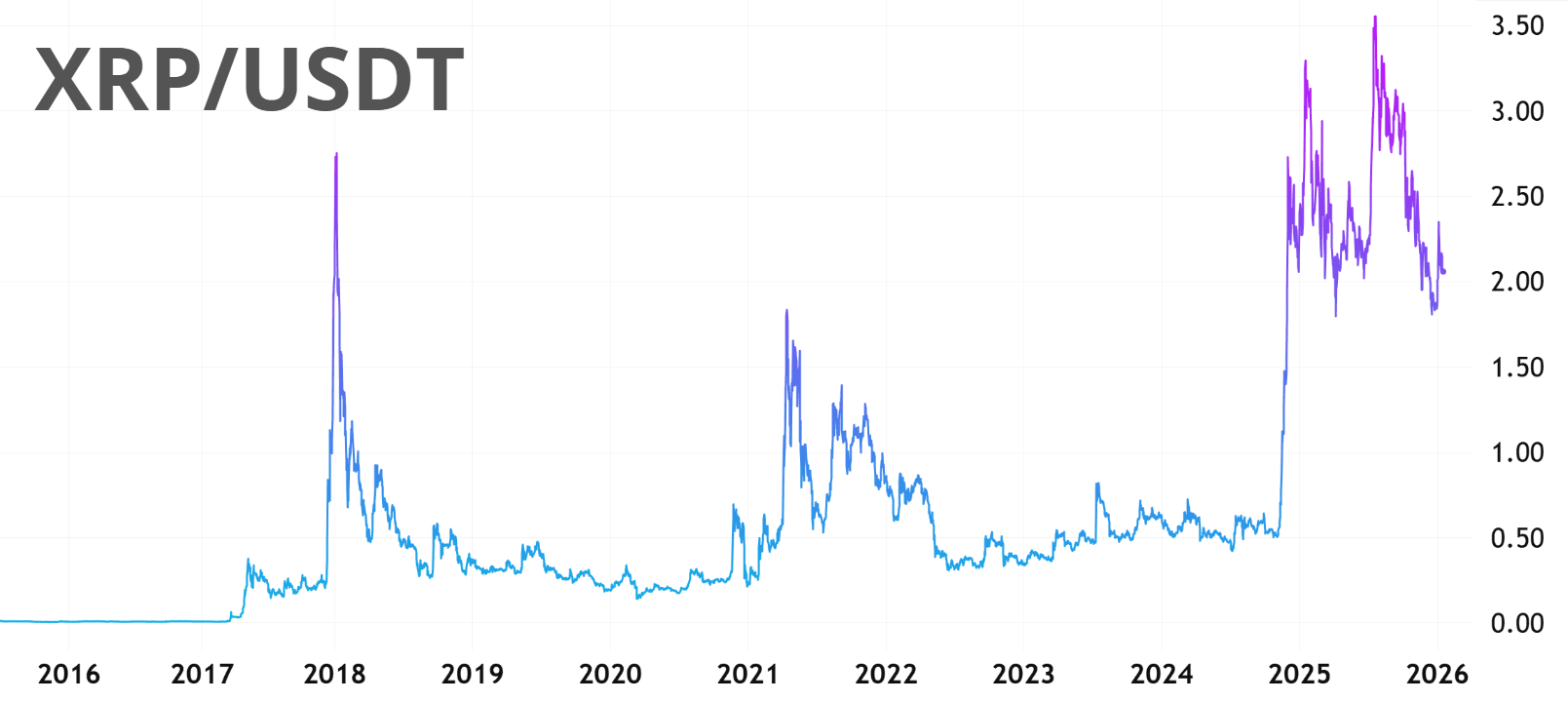
Launched in 2012, XRP spent several years trading below one cent before surging during the 2017 crypto bull run, reaching an initial all-time high of $3.30 in January 2018. The rally was fuelled by optimism surrounding Ripple’s global payment solutions and institutional partnerships.
After 2018, XRP experienced a prolonged decline, dropping below $1 and remaining under pressure throughout the SEC lawsuit and the impact of founder Jed McCaleb's token sales, which ended in 2022. While the 2021 bull market briefly returned the price to above $1, uncertainty from the unresolved legal case limited further gains.
Momentum surged back in 2024, fuelled by progress towards regulatory clarity and the launch of its stablecoin, RLUSD. This resurgence resulted in XRP rising nearly 500% that year. Following the legal settlement with the SEC and the successful launch of RLUSD, XRP hit a new all-time high of $3.67 in early 2025. Since then, XRP has largely consolidated above the $2 support level, aided by improved sentiment, increased institutional use, and the ongoing growth of its ecosystem.
Year |
Lowest Price (USD) |
Highest Price (USD) |
2017 |
0.003 | 2.47 |
2018 |
0.245 | 3.32 |
2019 |
0.175 | 0.505 |
2020 |
0.114 | 0.79 |
2021 |
0.208 | 1.97 |
2022 |
0.287 | 0.918 |
2023 |
0.3 | 0.948 |
2024 |
0.426 | 0.745 |
2025 |
1.58 | 3.67 |
Year |
High |
Year |
Low |
Pullback % |
2018 |
3.32 |
2020 |
0.114 | -96.6% |
2021 |
1.97 |
2022 |
0.287 | -85.4% |
The prices and forecasts displayed in this table and the sections that follow originate from third-party data and aim to offer an overview of current market sentiment.
| Source / Year | 2026 | 2027 | 2030 | 2040 | 2050 |
| AMBCrypto | $2.47 - $3.70 | $2.54 - $3.81 | $4.64 - $6.96 | * | * |
| Consensus rating (Binance users) | $2.35 | $2.46 | $2.85 | * | * |
| CoinCodex | $2.18 - $2.53 | * | $2.88 - $7.51 | * | $20 max. |
| CoinPedia | $5.50 - $8.50 | $7.00 - $13.25 | $17 - $26.50 | $97.50 - $179 | $219 - $526 |
| Digital Coin Price | $4.99 - $5.94 | $6.86 - $8.38 | $11.04 - $12.66 | * | * |
| Standard Chartered (Geoffrey Kendrick) | $8.00 | $10.40 | * | * | * |
| Techopedia | $3.90 - $8.60 | * | $5.00 – $26.97 | $6.34 - $26.97 | * |
| Coinlore | $2.28 - $3.16 | $0.73 - $2.56 | $9.15 | $31.42 | * |
* Price prediction not provided from this source for this year. Forecasts about future performance may not occur.
Most websites that predict cryptocurrency prices base their forecasts on historical price data, technical indicators, and market sentiment. These models are typically non-transparent, unverified, and not supported by formal backtesting, meaning their accuracy cannot be independently confirmed. Forecasts from these sources should therefore be viewed as speculative opinion rather than reliable financial projections.
Looking ahead to 2026, XRP price predictions range from moderate to bullish. According to CoinCodex, XRP is expected to trade between $2.18 and $2.53 next year, representing a potential 12.27% increase if it hits the upper target of $2.53.
According to Techopedia, which cites insights from market experts, XRP could reach $3.90 to $8.60 by 2026. Their outlook is based on continued adoption in cross-border payments and positive market sentiment following Ripple's legal progress.
Meanwhile, CoinLore, which uses historical price patterns, technical indicators like RSI, MACD, and Fibonacci levels, as well as AI-based models, predicts that XRP will rise to around $3.16 by 2026.
By 2027, forecasts become more ambitious as analysts anticipate increased institutional adoption. Geoffrey Kendrick, Standard Chartered's Global Head of Digital Assets Research, bases his forecast on three key factors: a favourable resolution of Ripple's ongoing SEC case, the increased use of XRP in international payments, and the possibility of a spot XRP ETF, which could attract significant investor inflows.
According to DigitalCoinPrice, which uses a trend-based model to analyse historical data, XRP could trade between $6.86 and $8.38 in 2027. AMBCrypto, on the other hand, has a more moderate outlook, predicting that XRP will trade between $2.54 and $3.81 based on past price action, current developments, and community sentiment.
Moving forward to 2030, XRP price predictions continue to vary greatly. According to Binance user consensus data, XRP will increase by about 5% by 2030, bringing it closer to $2.85.
CoinCodex provides a broader range of $2.88 to $7.51, claiming that XRP could gain more than 230% if it reaches the higher target. Meanwhile, Coinpedia predicts that XRP will reach $26.50 by 2030, owing to consistent growth in market capitalisation.
Techopedia, citing Ryan Lee of Bitget Research, predicts XRP trading between $5 and $26.97, particularly if adoption in the remittance and cross-border payment sectors picks up.
Long-term predictions become more speculative as we move forward. Experts interviewed by Techopedia believe XRP could reach double-digit valuations, with the most optimistic estimates putting the token at $27 between 2030 and 2040, assuming the protocol continues to perform well and global adoption grows.
Forecasts become highly uncertain by 2050 due to the volatile nature of the cryptocurrency market. According to CoinCodex's algorithmic model, XRP is unlikely to reach $100, with a maximum projected price of around $20.00. This projection points to both XRP's long-term potential and the inherent difficulties of forecasting several decades into the future.
With its near-instant settlements and low transaction fees, Ripple's technology stands poised to democratise access to the global financial network. It will aim to enable smaller banks to avoid traditional, slow systems, potentially resulting in more efficient trading corridors.
The outcome of the SEC case, along with the introduction of the compliant RLUSD stablecoin, has given Ripple clear rules to follow and the necessary resources to speed up the adoption by big institutions around the world. Traders pay close attention to institutional interest as a key indicator of long-term price momentum.
As Ripple integrates its technology with major financial institutions and expands the utility of the XRP Ledger through cross-chain features and AI partnerships, XRP has the potential to lead the digital transformation of global financial payments.
Finally, while price predictions outline a wide range of possibilities, its future performance will be heavily reliant on sustained institutional adoption, the continued growth of the XRPL ecosystem, and the overall trajectory of global crypto regulation. These are the key fundamental drivers that traders should consider when determining XRP's long-term value.
Ready to trade your edge?
Join thousands of traders and trade CFDs on forex, shares, indices, commodities, and cryptocurrencies!
Data is sourced from third party providers. This information is not to be construed as a recommendation; or an offer to buy or sell; or the solicitation of an offer to buy or sell any security, financial product, or instrument; or to participate in any trading strategy. It has been prepared without taking your objectives, financial situation and needs into account. Any references to past performance and forecasts are not reliable indicators of future results. Axi makes no representation and assumes no liability with regard to the accuracy and completeness of the content in this publication. Readers should seek their own advice.
