What is prop trading?
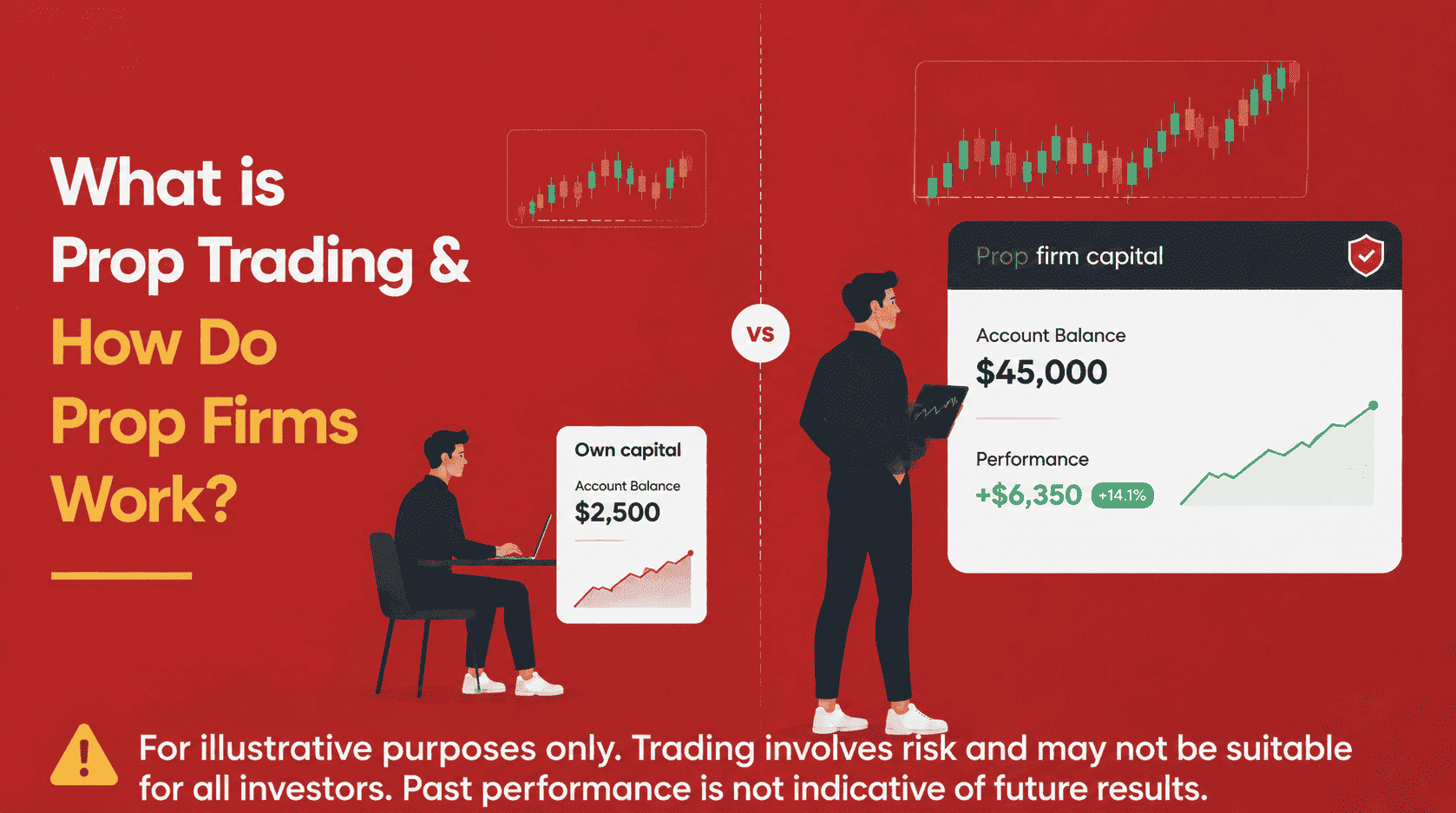
Proprietary trading, commonly referred to as prop trading, describes the practice where traders engage in trading activities using the capital of a prop firm or financial institution rather than their own capital. These traders participate in a range of financial markets and use a variety of financial instruments, including shares, options, futures, and contracts for difference (CFDs). The primary goal of prop trading is to generate profits for the institution using the capital allocated by the firm for trading.
While there are businesses that only engage in prop trading, it is also a practice by:
- Investment banks that have desks specialising in proprietary trading. Banks benefit from having extremely valuable information and order flow visibility. However, prop trading within the banks has become heavily regulated since the financial crisis of 2008.
- Hedge funds that trade their own funds as well as managing funds for their investors.
- High-frequency trading firms that also act as market makers.
- Commodity trading firms, such as Glencore, Vitol, and Trafigura, that trade commodities on the physical and futures markets.
What is a prop trading firm?
A prop firm is a company that provides its traders with access to capital. In return, the traders share a percentage of the profits they generate with the company.
Individuals face many hurdles on their journey to become professional traders. While a lack of sufficient capital is the most obvious one, they may also lack access to technology, market data, and tools. Prop firms can help skilled individuals propel their trading careers by providing capital, training, and general support.
The setup of prop firms varies significantly. Some prop trading companies have physical offices and provide a desk for their traders. Others operate entirely remotely, accepting traders into their programs from across the globe.
What is a prop trader?
An individual who trades using the firm's own funds instead of client funds is known as a prop trader. To make money for the company, they typically participate in speculative trading, which can involve both short- and long-term trading.
Proprietary trading firms typically allow their traders autonomy in making trading decisions. However, they establish a limit known as the maximum drawdown level. If a trader's losses reach this predefined threshold, the firm will intervene and suspend the trader's trading activities to mitigate further financial risks.
Prop traders make all or most of their income from splitting profits they generate in financial markets with the prop firm that provides them with capital.
Prop traders face the same challenges as other traders but benefit from access to capital, technology, and interaction with other skilled traders.
How does prop trading work?
When a trader is accepted by a proprietary trading firm, they are allocated a certain amount of capital to trade with. The size of this capital allocation, as well as the proportion of profits the trader is entitled to keep, varies depending on the trader's level of experience and their track record of past trading results.
Prop traders employ a variety of trading strategies, from short-term trading to swing and position trading. Similarly, traders may use either fundamental or technical analysis when analysing markets, or a combination of the two.
While risk management remains critical, trading on behalf of a prop firm is subject to more stringent regulations and increased scrutiny in order to limit the firm's capital exposure to potential losses.
How do prop firms work?
To explain how prop firms work, we will use a hedge fund analogy.
Hedge funds rely on clients who provide the company with capital. The fund managers ultimately answer to their clients, who receive an average of 60–80% of the profit generated.
Prop firms, on the other hand, don't take on clients as investors. Instead, they use their own corporate capital to generate profits in financial markets. This allows them greater freedom, flexibility, and the opportunity to keep a larger percentage of the overall returns.
For traders looking to access prop firm capital, the most common route is through a funded trading account. For a detailed breakdown of how funded accounts work, see What is a funded trading account.
How do prop firms make money?
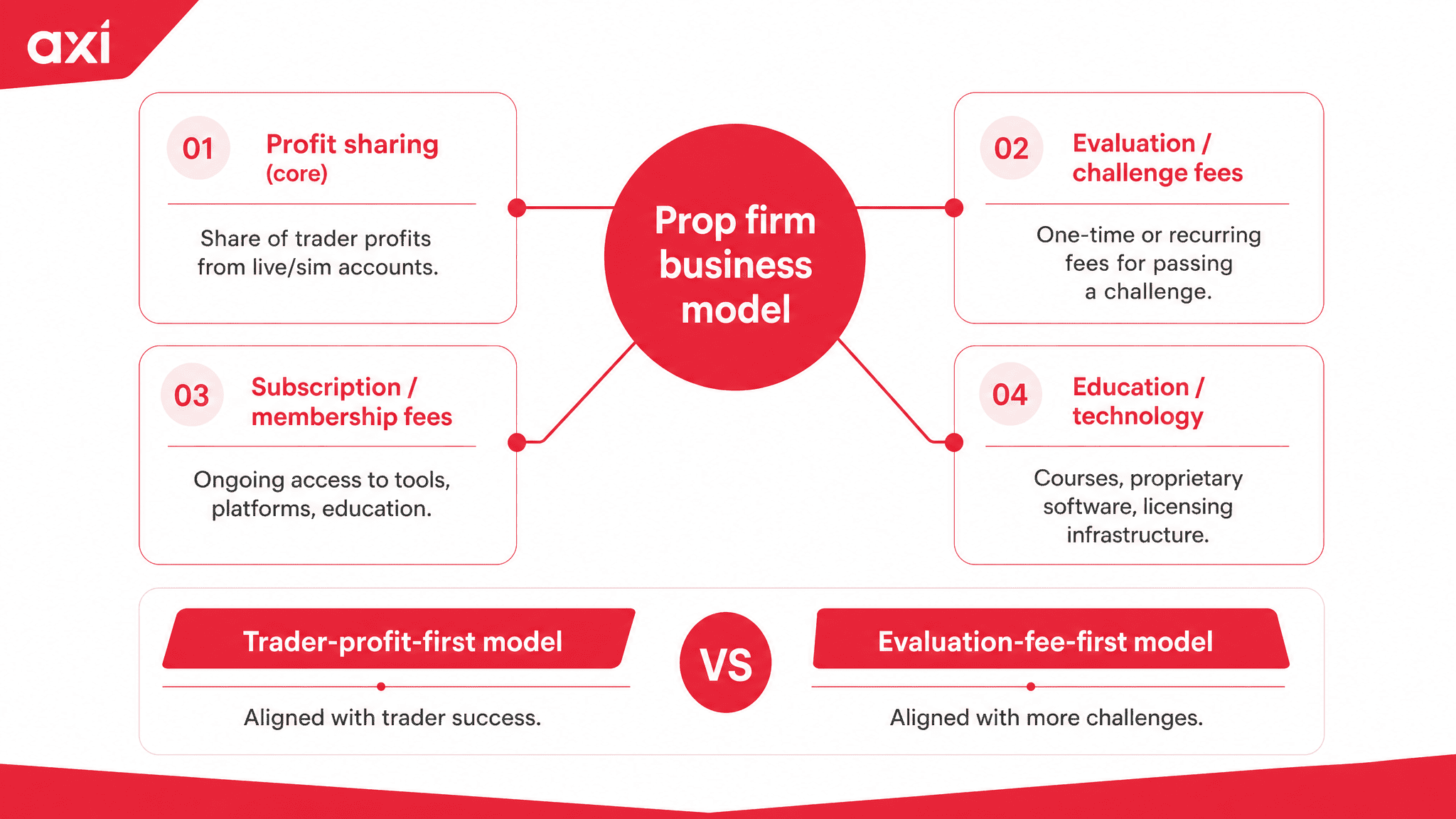
Most revenues generated by a prop firm come from the profits generated by the prop traders. Firms have a profit-sharing arrangement in place with their traders. For example, a trader that generates $100,000 in profits during a certain period and has a 40/60 profit share agreement will receive $40,000, while the remaining $60,000 goes to the firm.
Some prop firms, particularly the smaller ones, may earn revenue by providing education, granting access to their capital allocation program, or utilising their office space and/or technology. However, this is usually only a minor fraction of the revenue generated.
Other firms will charge a subscription or membership fee. Traders might have to complete a challenge before they can officially join the program and receive funding, and some companies may charge them for this opportunity.
However, this model is in the process of being phased out amid an intense crackdown by regulators and technology providers.
How do prop traders make money?
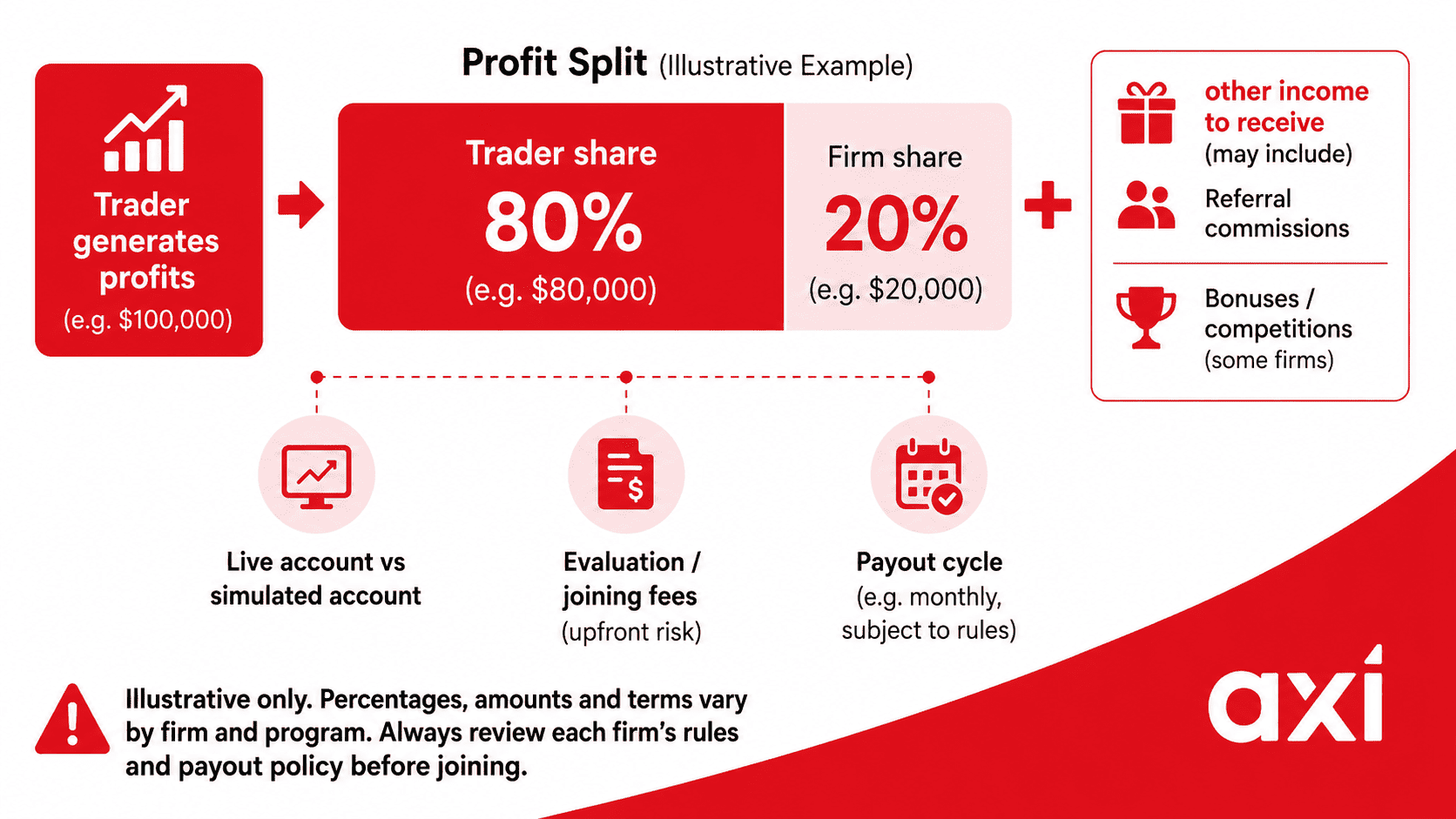
Prop traders make money by earning a profit share, a percentage of the profits they generate using the firm's capital. This is their primary source of income.
The percentage a trader receives varies by firm and program. Most prop firms currently offer profit shares ranging from 80% to 100%, though the conditions attached vary significantly. Firms offering higher splits often operate on simulated accounts and charge upfront evaluation fees, meaning traders risk their own money before ever seeing a payout.
Beyond the standard profit share, some firms offer commissions for referring new traders to the program.
Advantages of prop trading
Prop trading can provide individual traders with several advantages:
- Potentially maximising their profits: talented traders may lack the funds to scale up their operations. To illustrate, it will be difficult for a trader to generate a significant return on a $200 account, particularly if they refrain from undertaking excessive risks. Property firms may offer these exceptionally skilled traders the chance to establish themselves as professional traders and potentially generate substantial profits.
- Autonomy: Although each prop firm will put in place its own risk management guidelines to guard against uncontrollably large losses, traders typically have a great deal of latitude and discretion in how they use the money that has been allocated to them.
- Learning curve: Working with other talented traders and seasoned professionals can provide traders with an incredible learning opportunity and the chance to build meaningful connections.
- Technology: Access to technology can be costly, with expenses for data feeds, professional charting software, live news feeds, and expert insights adding up quickly. High-end tools, such as Bloomberg terminals, are also significant investments. Proprietary trading firms provide their traders with all these technological resources, enabling them to make better-informed decisions without the individual cost burden.
- Potentially lower their risk: The trader assumes reduced financial risk due to the provision of capital by the prop firm.
Disadvantages of prop trading
While we have emphasised several significant benefits of prop trading, it is not without its drawbacks:
- Increased pressure: If you are purely trading your own funds, you ultimately do not report to anyone. However, trading with the capital of a prop firm comes with responsibility, and the firm will expect the traders to hit their targets.
- Lack of stability: Prop firms typically don't have a lot of patience with underperformers, and they are easily removed from the capital allocation program.
- Upfront fees: Some programs demand traders to pay a membership or joining fee as well as pass so-called "challenges" in order to participate. This can be a financial burden for traders as well as an unpleasant experience. These business tactics are currently scrutinised by regulators and technology providers as they can be used to manipulate traders in false promises of future profits. Traders pay a registration fee and then must jump through multiple hoops to qualify for funding. In most cases, they never qualify.
How to get started with prop trading
The entry requirements to join a prop firm vary significantly. For example, a traditional prop firm whose traders are based in a physical office, equipped with advanced institutional infrastructure, and supported by extensive internal training will have strict entry requirements, a long screening process, and a limited number of open positions.
On the other hand, remote prop companies that focus on providing funded accounts online make it much easier for talented traders to join. In a typical remote setup, a trader pays a joining or subscription fee before participating in a challenge or assessment period. They must demonstrate their trading abilities on a demo account while adhering to strict maximum drawdown limits and profit targets. If the trader successfully completes the challenge, they are admitted into the program and become eligible for future funding increases.
Ready to trade your edge?
Join thousands of traders and trade CFDs on forex, shares, indices, and commodities!
This information is not to be construed as a recommendation; or an offer to buy or sell; or the solicitation of an offer to buy or sell any security, financial product, or instrument; or to participate in any trading strategy. It has been prepared without taking your objectives, financial situation and needs into account. Any references to past performance and forecasts are not reliable indicators of future results. Axi makes no representation and assumes no liability with regard to the accuracy and completeness of the content in this publication. Readers should seek their own advice.
FAQ
Prop trading is the practice where traders engage in trading activities using the capital of a prop firm or financial institution rather than their own capital.

Milan Cutkovic
Milan Cutkovic is an experienced trader and market analyst specializing in forex, indices, commodities, and stocks. He was one of the first traders accepted into the Axi Select program, which identifies talented traders and supports their professional development.
He is passionate about helping others improve their trading skills through educational articles, eBooks, and content published on the Axi blog. His work is regularly featured and quoted in major international media outlets, including Yahoo Finance, Business Insider, Barron's, CNN, Reuters, New York Post, and MarketWatch.